
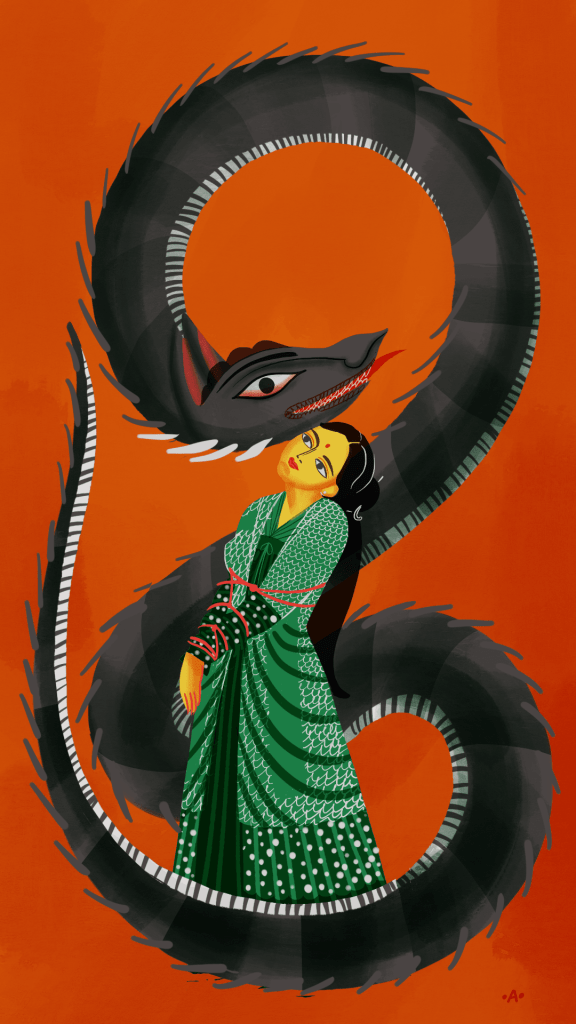
I read this interview ages ago but it is still seared in my mind. On the incestuous nature of nationalism by Iranian archeologist Hamid Parsani via Chimurenga Mag:
The problem of state – which is the term for the earth’s vivisection by competing delusions of mastery, delusions specific to the particular technological-human configurations you call economy – has always been a problem of law in its purist, and therefore most incestuous, sense. We might invoke here the figure of Aži Dahāka or Zahhāk (کاحض), the dragon tyrant that committed incest with his own mother.
This type of law, sovereign law, is an absolute residue of the divine, its complete absence. Its form is apophasis: it reigns everywhere without control, it assumes the physical form of absence only when violated, when a criminal demonstrates the powerlessness of law through his transgression. The phenomena of borders compounds this paradox because the border at once emanates from the law but also circumscribes its domain by binding the divine residue to a particular stretch of earth, therefore making God’s excrescence slave to the human. One can never occupy a border. One can only pass in between absent Gods. Reaching the border would be a violation of Zeno’s dichotomy paradox. It would involve a subluminal unity with chaos, with what the Zoroastrians call druj (غورد), the root of “lie” in Persian, with the mutual antithesis of both the godhead and creation. Satan.
The priests of the law, however, are consumed by sacrilege and seek to rebuild heaven on the surface of the planet, a crime against both law and earth. The state is one name for this crime. The state is a reflection: an anti-paradise, a mirror image of Eden.
Anticipating when the law will be broken (a border breached, for example), the priests create rituals of power in advance of the manifestation of divine absence: castles, watchtowers, bridges, dungeons, gallows, border stations, demilitarised zones. They claim to be defending order and the divine will by waiting for the moment that the law will be broken. This human arrogance simply mocks God by creating a twisted caricature of reason. In saying all of this, I should emphasise that I am using the term “divine” figuratively. It is essentially the limit of the earth, the limit that the earth constantly comes up against and then uses to remake itself as ground, as foundation in both senses of the word.
 Aindri C
Leave a comment